

How can a Dutch company get cited in ChatGPT, Gemini, Perplexity, and Copilot answers?
TL;DR
You cannot guarantee an AI citation. You can increase the probability by becoming easy to discover, easy to understand, and safe to quote. For a Dutch company, that means: allow the relevant crawlers; secure Google and Bing indexation; state exactly who the company is, what it does, where it operates, and why it is credible; publish original Dutch and English evidence that answers real buying questions; earn independent corroboration; and measure citations with a fixed prompt set over time.
- ChatGPT: Allow OAI-SearchBot. GPTBot controls potential training use separately; blocking GPTBot does not require blocking ChatGPT Search.
- Gemini and Google AI features: Win through Google Search fundamentals. Google says there is no special AI markup and that llms.txt does not help Google Search.
- Perplexity: Allow PerplexityBot and keep pages public, fast, specific, and well-sourced.
- Copilot: Make Bing discovery a first-class workstream. Microsoft says Copilot web search sends a short query to Bing; use Bing Webmaster Tools and IndexNow.
- Dutch trust layer: Show consistent legal identity and contact details, including the KVK number and visiting address where required; use genuine reviews; publish clear policies; and keep Dutch and English pages on separate URLs with hreflang.
- Best content: First-hand research, benchmarks, price/methodology pages, expert explainers, comparisons, case studies with verifiable numbers, datasets, and concise definitions. Commodity summaries are replaceable; evidence is citable.
- Measure outcomes, not vanity: Index coverage, crawler access, citation rate, brand mention rate, citation share of voice, source-page mix, AI referral sessions, qualified leads, and assisted revenue.
How AI citation visibility actually works
AI answer systems do not offer a single, stable ranking position. A typical public-web answer involves several gates: the system decides whether to search, turns the prompt into one or more retrieval queries, finds eligible pages, selects sources, synthesizes an answer, and may display a citation. A company can fail at any gate even when its conventional SEO is healthy.
That is why SEO, AEO, and GEO overlap but are not identical. SEO makes pages discoverable and competitive in search indexes. AEO makes an answer clear and extractable. GEO improves the chance that a generative system retrieves, trusts, cites, mentions, or materially uses the content. Google now describes its AI search experience as retrieval-augmented generation with query fan-out, while also stressing that foundational SEO remains the base.
| Layer | Questions to answer | Primary lever |
|---|---|---|
| 1. Access | Can the platform fetch the page? | robots.txt, WAF/CDN rules, HTTP status and rendering |
| 2. Discovery | Has the system or its search partner found the URL? | Internal links, XML sitemap, Google Search Console, Bing Webmaster Tools and IndexNow |
| 3. Eligibility | Can the page be indexed and shown with a useful snippet? | Canonical tags, indexability, content parity and no accidental noindex or nosnippet directives |
| 4. Relevance | Does the page directly satisfy the user’s task and likely fan-out queries? | Topic coverage, answer-first sections, entities, language and location relevance |
| 5. Trust | Is the claim credible enough to repeat? | Named experts, transparent methods, reliable sources, first-hand evidence and independent corroboration |
| 6. Selection | Is this one of the best sources for this answer? | Unique information gain, precision, freshness and authority |
| 7. Outcome | Did the system cite, mention, influence or send a visitor? | Prompt tracking, citation reviews, analytics and conversions |
A 2026 research survey cautions that GEO evidence and metrics remain heterogeneous, and that visibility is better treated as a vector than a single rank. Another study separates citation selection from citation absorption: being listed as a source does not prove the answer used your evidence meaningfully. Build measurement around that uncertainty instead of promising a number-one AI ranking.
What differs by platform?
| Platform | Public-web route | What a Dutch company should prioritize |
|---|---|---|
| ChatGPT | OpenAI’s OAI-SearchBot supports ChatGPT Search. Search access is controlled separately from GPTBot training access. | Allow OAI-SearchBot and its published IP ranges; keep definitive source pages public; track referrals containing utm_source=chatgpt.com. |
| Gemini / Google AI | Google AI features draw on Google Search systems, retrieval-augmented generation and query fan-out. | Prioritize indexability, original people-first content, Google Business Profile and Merchant Center where relevant, and structured data that helps Google understand the content—not supposed AI hacks. |
| Perplexity | PerplexityBot indexes public pages and follows robots.txt. Blocked pages may retain only limited facts. | Allow PerplexityBot; publish concise, sourced and current pages; avoid hiding important evidence behind logins, scripts or consent overlays. |
| Microsoft Copilot | Microsoft states that Copilot web search generates a short query and sends it to Bing. | Use Bing Webmaster Tools, submit an XML sitemap, maintain strong Bing index coverage, use IndexNow for additions, updates and deletions, and create pages that satisfy concise query reformulations. |
Important distinction: Microsoft 365 Copilot can also ground answers in an organization's private work data. Public-site optimization targets Copilot's web search route; it does not make your company appear within another company's private Microsoft Graph unless that organization already has your content or adds an authorized connector.
The 12-step GEO and AEO framework for Dutch companies
1. Start with the questions that can create commercial value
Do not begin with “How do we rank in AI?” Begin with decisions your audience delegates to an answer engine. Map prompts across the funnel and across Dutch and English. Keep one primary page for each durable intent, then use supporting pages for narrower evidence.
| Intent | Dutch example | English example | Best source format |
|---|---|---|---|
| Category education | Wat is een cybersecurity-audit en wanneer heb ik die nodig? | What is a cybersecurity audit, and when do I need one? | Expert explainer with clear decision criteria |
| Shortlist | Beste CRM-systemen voor Nederlandse mkb-bedrijven | Best CRM systems for Dutch SMEs | Transparent comparison or buyer’s guide |
| Fit | Is e-facturatiesoftware geschikt voor een klein bedrijf? | Is e-invoicing software suitable for a small business? | Use-case page with relevant constraints |
| Cost | Wat kost SEO-advies in Nederland? | How much does SEO consulting cost in the Netherlands? | Pricing methodology, price ranges and publication date |
| Risk | Voldoet cloudboekhoudsoftware aan de AVG? | Does cloud accounting software support GDPR compliance? | Security or compliance page reviewed by a qualified owner |
| Comparison | Boekhoudpakket A versus boekhoudpakket B | Accounting platform A versus platform B | Fair, sourced comparison with a “not suitable for” section |
| Local | B2B-marketingbureau in Utrecht | B2B marketing agency in Utrecht | Location or service page supported by genuine local evidence |
Use Search Console queries, Bing Webmaster Tools, sales-call notes, support tickets, on-site search, tender questions, review language, and customer interviews. Cluster semantically similar questions; do not publish one thin page for every wording variation. Google explicitly warns against scaled pages created mainly to manipulate AI results.
2. Make crawler access an explicit business decision
Audit robots.txt, CDN bot rules, firewall challenges, rate limits, cookie walls, geoblocking, and server logs. A WAF can still block a crawler allowed in robots.txt. Test the final HTML and assets from outside your office network.
Example robots.txt policy
This example allows search-oriented crawlers while opting out of OpenAI model-training crawl. Adapt it with legal, security, and publishing stakeholders; do not paste it blindly.
OpenAI states that OAI-SearchBot and GPTBot are independent controls and that robots.txt changes may take about 24 hours to adjust in its systems. Perplexity says PerplexityBot follows robots.txt.
3. Secure Google and Bing index eligibility
- Return HTTP 200 for canonical content. Fix soft 404s, redirect chains, redirect loops, and intermittent 5xx errors.
- Use one self-referencing canonical per indexable page. Keep the canonical in the same language when using hreflang.
- Submit clean XML sitemaps in Google Search Console and Bing Webmaster Tools. A sitemap is a discovery hint, not an indexing guarantee.
- Use IndexNow to notify participating engines when URLs are created, materially updated, or deleted. Microsoft positions the protocol as a faster discovery mechanism, not a promise of ranking.
- Ensure the meaningful article, product, service, author, price, and policy content exists in rendered HTML and is not dependent on an interaction that crawlers cannot perform.
- Check robots meta tags and X-Robots-Tag headers. Accidental noindex, nosnippet, or restrictive max-snippet directives can remove eligibility or limit extractable text.
- Keep desktop and mobile content materially equivalent and provide a usable, secure HTTPS experience.
4. Establish an unambiguous Dutch business entity
A citation system should not have to guess whether your trading name, legal entity, product, and branch are the same organization. Make a canonical About page and connect it consistently from the homepage, author pages, contact page, policy pages, profiles, directories, and structured data.
- State the registered name, trading name, one-sentence category, core services or products, audiences, service area, founding date where relevant, and parent or subsidiary relationship.
- Show consistent contact and legal details. Dutch government guidance says a business website must make clear who the customer is dealing with and gives the KVK number and visiting address as examples.
- Use Organization or the most specific LocalBusiness subtype where appropriate. Google says Organization structured data can help it understand and disambiguate administrative details.
- Use sameAs only for profiles that unambiguously represent the same entity—never a loose collection of unrelated mentions.
- For a local business, claim and fully maintain Google Business Profile. Google describes local results through relevance, distance, and prominence; there is no payment route to better organic local ranking.
- For ecommerce, maintain accurate product, price, availability, shipping, and returns data in page markup and merchant feeds.
5. Build E-E-A-T into the page, not into a badge strip
Google describes trust as the most important part of E-E-A-T, with experience, expertise, and authoritativeness contributing to it. Turn those concepts into visible, verifiable page elements.
| E-E-A-T element | On-page implementation | Proof stronger than a claim |
|---|---|---|
| Experience | Describe what was tested, delivered, measured, observed or learned first-hand. | Original screenshots, field notes, sample sizes, before-and-after data and clearly stated limitations |
| Expertise | Name the author and reviewer, and explain their relevant roles, credentials and experience with the topic. | Detailed author profiles, professional registrations where relevant and previously published work |
| Authoritativeness | Become a recognized and frequently referenced source within the niche. | Independent editorial mentions, contributions to standards, conference presentations and university or industry partnerships |
| Trust | Make claims auditable and hold the company accountable for the information it publishes. | Sources, methodology, corrections policy, publication dates, legal and contact details, and privacy and security information |
For high-stakes topics—health, finance, law, cybersecurity, and safety—raise the evidence bar. Have a qualified subject-matter reviewer, cite primary sources, state the jurisdiction and date, describe uncertainty, and avoid advice outside the company's competence.
6. Publish information gain: facts others cannot copy
The strongest citation asset is not another generic trend article. It is a page that adds something the answer needs and that competing sources cannot supply as well. Google's 2026 guidance calls this non-commodity content and highlights first-hand viewpoints over recycled summaries.
- A Netherlands benchmark with sample, timeframe, definitions, and downloadable methodology.
- A pricing study that explains VAT treatment, included scope, exclusions, and regional differences.
- A case study with baseline, intervention, measured outcome, attribution caveats, and customer approval.
- A comparison matrix with explicit criteria, evidence links, update date, and honest disadvantages.
- A calculator, checklist, template, dataset, map, glossary, or decision tree that solves a real task.
- A regulatory explainer tied to the Dutch or EU context and reviewed on a named date.
- An expert forecast that separates observation, inference, and opinion.
The foundational GEO study reported that adding citations, relevant quotations, and statistics improved visibility in its benchmark, sometimes substantially, but the effect varied by query domain. Treat this as directional research—not a universal production guarantee. Use statistics only when they are real, sourced, dated, and necessary.
7. Write answer-first without turning the page into fragments
For each major question, lead with a complete two-to-four-sentence answer, then explain the evidence, conditions, examples, and next steps. Use descriptive headings, concise definitions, lists for genuine sets, and tables for genuine comparisons. Put the answer close to the question. Preserve narrative depth; Google says there is no requirement to “chunk” pages into tiny blocks for AI.

A reusable answer block
Question: How long does GEO take for a Dutch company?
Direct answer: A technically healthy site can become eligible as soon as relevant crawlers and search indexes refresh, but reliable citation growth usually requires repeated publishing, corroboration, and testing over months. No platform guarantees a timeline or a citation. Separate fast technical fixes from slower authority-building, and report progress by prompt cohort rather than by one anecdotal answer.
Evidence and conditions: Show what changed, when crawlers revisited, whether pages became indexed, which prompts triggered web search, and whether citations persisted across repeated tests.
8. Build a topic system, not a pile of blog posts
Choose a small number of commercially relevant entities and decisions your company can credibly own. Build a hub that defines the topic and links to evidence pages: methodology, pricing, comparisons, use cases, locations, compliance, case studies, glossary terms, datasets, and FAQs. Link back with descriptive anchors. Remove or merge overlapping pages that compete for the same intent.
| Page type | Job | Minimum evidence |
|---|---|---|
| Category hub | Define the market and guide users through their choices | Expert owner, clear decision framework and links to supporting evidence |
| Service or product page | Explain suitability, features, process, pricing logic and limitations | Specifications, eligibility requirements, supporting proof, policies and a clear CTA |
| Comparison | Help buyers make a fair and informed choice | Comparison criteria, reliable sources, update date, alternatives and a “not suitable for” section |
| Case study | Demonstrate first-hand results | Baseline, methodology, timeframe, results, caveats and customer consent |
| Research or data | Become a primary source of information | Methodology, sample size, metric definitions and downloadable data where possible |
| Expert FAQ | Answer relevant follow-up questions | Concise answers with internal links and links to primary sources |
9. Localize for Dutch and international demand
Do not auto-redirect every visitor or crawler to one language. Use stable, separate URLs for Dutch and English; translate the full main content; give users a visible language switcher; and connect alternates with reciprocal hreflang. Google recommends explicit language and version signals and language-specific URLs for multilingual sites.
- Use nl-NL for Dutch content aimed at the Netherlands and en-NL only when the English page is specifically for users in the Netherlands. Use en for broadly English content when that is the real target.
- Translate examples, currency, VAT context, regulations, address format, testimonials, screenshots, and search language—not just navigation labels.
- Keep each language page self-canonical. Do not canonicalize the Dutch page to the English page.
- Create city or province pages only when the business has genuine location-specific service, proof, staff, inventory, or constraints. Swapping a city name into duplicate copy is not localization.
- For .nl, .com, and .eu variants, define the audience and canonical ownership clearly. A .nl domain is a trust cue for many users, but content and market fit still do the work.
10. Use structured data as a clarity layer
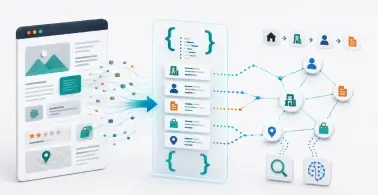
Structured data can help machines understand entities and page types, and Google recommends JSON-LD for supported rich-result features. It is not a direct AI-citation switch. Google explicitly says there is no special Schema.org markup required for generative AI search.
- Homepage/About: Use Organization or a specific LocalBusiness subtype. Include the name, URL, logo, contact details, address, VAT identifier where appropriate, and genuine sameAs profiles.
- Blog: Use BlogPosting or Article. Include the headline, image, author as a Person or Organization, datePublished, dateModified, publisher, and canonical mainEntityOfPage.
- People: Use Person on a substantive author page, with role, expertise, worksFor, and verified profiles.
- Products/services: Use supported Product, Offer, Service, review, shipping, and return-policy properties only when they match the visible page content and platform guidelines.
- Breadcrumbs: Reflect the actual hierarchy and support navigation.
- FAQs: Keep useful, visible questions and answers, but do not promise Google FAQ rich results. Google generally limits those rich results to well-known government and health sites.
Illustrative BlogPosting JSON-LD
The following is an implementation example, not markup to paste unchanged. Replace the sample organization, author, logo, and URL with verified details that are also visible on the published page.
11. Earn independent corroboration ethically
Self-published claims establish what you say about yourself. Independent sources establish what others can verify. Pursue legitimate coverage and citations where your customers and industry already look: trade media, professional associations, standards bodies, chambers, research partners, universities, conferences, procurement ecosystems, respected niche newsletters, and credible directories.
- Pitch data, expertise, or a useful tool—not a request for a link with no editorial value.
- Keep the brand name, category, URL, location, and description consistent across profiles.
- Give journalists and partners a source page with methodology, charts, definitions, spokesperson details, and reusable facts.
- Ask customers for genuine reviews without scripting sentiment or suppressing negative feedback. Dutch guidance prohibits fake reviews and influencing reviews by removing negative ones.
- Correct inaccurate third-party information through the publisher's normal process. Do not create fake citations, profiles, awards, or community discussions.
- Measure coverage quality, relevance, and evidence pickup—not raw mention volume.
12. Refresh, distribute, and measure
Freshness is not changing the date. Review the facts, links, prices, regulations, product details, screenshots, and recommendations; record what changed; update the date only when the page changes materially; and notify search engines. Google recommends visible publication and update dates aligned with structured data.
Distribute original research to the people who can validate and cite it. Repurpose carefully into presentations, short posts, videos, newsletters, and partner resources while preserving one canonical source of truth.
The Dutch trust and compliance layer
GEO does not override Dutch and EU law. Trustworthy pages should satisfy both the user's decision and the company's obligations. The following is a publishing checklist, not legal advice.
- Identity: Make the contracting business clear and include required business information, such as the KVK number and visiting address, where applicable.
- Privacy: Publish an easy-to-find privacy statement, collect only data you have a lawful reason to collect, and apply GDPR principles.
- Cookies: Obtain consent where required and do not block core informational content behind a consent interaction.
- Reviews: Explain how reviews are collected and verified. Do not fabricate, selectively hide, or misrepresent them.
- Online sales: Show complete material product or service information, total prices and mandatory costs, delivery, returns, cancellation, and seller identity. ACM guidance emphasizes clear, non-misleading consumer information.
- Accessibility: Meet applicable European and Dutch accessibility obligations and make content usable with a keyboard, screen reader, zoom, and mobile devices.
- Claims: Retain substantiation for performance, sustainability, security, medical, financial, and comparative claims. Distinguish evidence from opinion.
- Corrections: Provide a contact route and correction policy for factual errors in research-led content.
A 90-day implementation roadmap
| Timing | Work | Definition of done |
|---|---|---|
| Days 1–14 | Baseline and technical eligibility | Define the Dutch and English prompt sets; approve the crawler policy; complete Google and Bing verification; audit logs, robots.txt, WAF rules, canonical tags, XML sitemaps, rendering and index coverage. |
| Days 15–30 | Entity and trust foundation | Update the About, contact, author, editorial, corrections, privacy, legal, review and core commercial pages; validate Organization or LocalBusiness and Article structured data. |
| Days 31–60 | Citation asset sprint | Publish or substantially improve three to five primary-source assets, such as a benchmark, methodology, pricing guide, comparison, case study, calculator or expert guide. Add Dutch and English versions only when the same quality can be maintained. |
| Days 45–75 | Corroboration and distribution | Pitch relevant trade publications, industry sources, partners, associations, customers and experts. Earn factual coverage and references, and correct inconsistent company profiles. |
| Days 61–90 | Measurement and iteration | Repeat prompt tests; classify mentions, citations and answer absorption; inspect cited source URLs; connect referral traffic to conversions; improve weak pages; document findings by prompt cohort. |
How to measure AI visibility without fooling yourself
Create a reproducible prompt panel
Build 30–100 prompts representing real customer tasks. Split them by funnel stage, language, market, location, product, and branded or non-branded intent. Store the exact prompt, platform, surface, account state, country, language, date and time, and whether web search was active. Run multiple trials because answers vary.
| Metric | Formula or definition | Why it matters |
|---|---|---|
| Web-search activation rate | Answers using live or public-web sources ÷ total tested answers | A citation may be impossible on some platforms when web grounding is not activated. |
| Brand mention rate | Answers naming the brand ÷ eligible answers | Measures brand recognition even when the answer does not include a link. |
| Citation rate | Answers citing your domain ÷ answers containing citations | Measures how frequently the platform selects your website as a source. |
| Citation share of voice | Your cited appearances ÷ all tracked competitor cited appearances | Shows your relative visibility across a defined prompt set. |
| Citation absorption | Cited answers in which your page materially supports a claim ÷ your total citations | Separates decorative source listings from genuine use of your evidence. |
| Source-page distribution | Share of citations by page type and URL | Reveals which content assets generate citations and visibility. |
| Referral quality | Engaged sessions, leads, pipeline and revenue generated by identifiable AI referrals | Connects AI visibility to measurable business value. |
| Persistence | Prompts for which visibility repeats across multiple runs and weeks | Distinguishes durable gains from random or short-term wins. |
For ChatGPT referrals, OpenAI says outbound search links include utm_source=chatgpt.com. Also review referrers, landing pages, server logs, consent-mode effects, and self-reported lead sources. Not every app or citation surface passes a clean referrer, so analytics will undercount.
Score the page before publishing
- Eligibility: Returns HTTP 200; indexable; canonical; included in the XML sitemap; crawling allowed; no blocked core resources.
- Directness: The primary question receives a complete answer near the top.
- Evidence: Important claims cite primary sources or first-party methods; dates and jurisdictions are clear.
- Experience: The page contains first-hand details, examples, screenshots, data, or operational lessons.
- Entity clarity: The company, author, product, location, and relationships are explicit and consistent.
- Information gain: At least one useful fact, method, tool, dataset, comparison, or insight is not a generic rewrite.
- Structure: Descriptive headings, readable paragraphs, useful lists or tables, descriptive links, and accessible media.
- Commercial honesty: Suitability, limitations, pricing logic, alternatives, and conflicts are transparent.
- Freshness: Visible publication and review dates are accurate; an update owner and cadence are assigned.
- Conversion: The next step is relevant but does not obstruct the answer.
What not to do
- Do not buy a “guaranteed ChatGPT ranking.” Citations are probabilistic, and platform behaviour changes.
- Do not mass-publish near-duplicate city, comparison, or FAQ pages. Google warns against scaled content abuse.
- Do not invent statistics, expert quotes, customer outcomes, awards, reviews, or third-party mentions.
- Do not treat schema as invisible content. Markup must match what users can see and should be validated.
- Do not assume llms.txt improves Google visibility. Google says it ignores llms.txt for Search. If you test it for another system, treat it as experimental and maintain it accurately.
- Do not block search crawlers at the WAF while robots.txt says Allow.
- Do not translate templates while leaving important evidence in another language.
- Do not update dates without substantive review.
- Do not optimize only for mentions. A flattering mention without a citation, visit, lead, or trust effect may have little business value.
- Do not report a single prompt screenshot as strategy success. Use repeated tests and a defined denominator.
Frequently asked questions
Not as a guaranteed organic citation. Advertising, product feeds, partnerships, and platform programs may create separate paid or commercial visibility, but they should not be represented as organic editorial citations. Evaluate paid and organic outcomes separately.
Final Checklist
- Relevant crawlers are allowed; the WAF and CDN are verified; server logs are monitored.
- Google Search Console and Bing Webmaster Tools are verified; sitemaps are clean; IndexNow is operational where useful.
- Canonicalization, indexability, rendering, mobile parity, HTTPS, speed, and accessibility are checked.
- Dutch legal identity, KVK and contact details, policies, and genuine-review practices are clear.
- Organization or LocalBusiness, Article, author, product or service, and breadcrumb markup are accurate where applicable.
- Dutch and English URLs are complete, self-canonical, connected through reciprocal hreflang, and locally adapted.
- Named authors and reviewers, first-hand experience, methodology, dates, limitations, and a correction route are visible.
- Content answers discovery, comparison, cost, fit, risk, local, and implementation questions.
- At least one defensible information-gain asset is published each quarter.
- Independent corroboration is earned ethically, and profiles are kept consistent.
- A fixed prompt panel is tested repeatedly across platforms, languages, and locations.
- Citation, absorption, referral, lead, pipeline, and revenue metrics are reviewed together.
Conclusion
A Dutch company earns AI visibility by becoming a better source, not by adding a magic file. The durable strategy is straightforward: make the website accessible to the right crawlers and search indexes; make the organization and authors unambiguous; answer real Dutch and international buying questions; contribute verifiable information that the web does not already have; earn independent corroboration; and test visibility like an experiment.
The practical standard is not “Did an AI mention us once?” It is: across a defined set of valuable customer questions, are we repeatedly retrieved, accurately represented, visibly cited, and chosen by qualified visitors? That is the bridge from SEO to AEO and GEO, and from vanity screenshots to commercial value.

Search
Categories
Recent Posts
- 20 Dec, 2024 Building Brand Loyalty: How Custom Mobile Apps Drive Business Success
- 17 Jan, 2025 Designing An Attractive and Truly User-Friendly Website!
- 23 Dec, 2024 Driving Sales Through Online Channels: Transforming Your Business with a Webshop
- 09 Sep, 2024 Enhancing Customer Engagement: The Business Benefits of Mobile App Development
- 23 Dec, 2024 Expanding Market Reach: The Strategic Value of an E-commerce Webshop
- 10 Mar, 2026 Google Review Card: NFC vs QR – What Works Better?
- 01 May, 2026 Google Tools for Websites: A Complete, Detailed Guide for Website Owners, Developers, and Marketers
- 09 Sep, 2024 Harnessing Professional Web Design: Elevating Your Business’s Online Presence
- 13 Jun, 2026 Headless CMS vs Traditional CMS: Which Should Your Business Choose?
- 09 Sep, 2024 How an Online Delivery System Empowers Business Operations
- 07 Aug, 2026 How can a Dutch company get cited in ChatGPT, Gemini, Perplexity, and Copilot answers?
- 18 Sep, 2026 How can I choose a reliable web development company in the Netherlands?
- 07 Sep, 2026 How do I improve local visibility in ChatGPT and Microsoft Copilot, not just Google Maps?
- 20 Jan, 2025 How To Build A Custom Website For Your Business?
- 31 Aug, 2026 How to Choose a Digital Marketing Agency in the Netherlands: Services, Costs and a Practical Checklist
- 20 Jan, 2025 How To Create A Professional Website For Building Online Presence?
- 02 Aug, 2024 How to Plan a Perfect Digital Market
- 25 Jun, 2026 How to Work With a Web Design Agency to Grow Your Online Presence?
- 23 Dec, 2024 Investing in Website Development: Enhancing Customer Engagement and Conversion Rates
- 23 Dec, 2024 Meeting Customer Expectations: The Competitive Edge of an Online Delivery System
- 23 Dec, 2024 Optimizing Logistics: Enhancing Business Agility with an Online Delivery System
- 17 Jan, 2025 Optimizing Your Website with a Website Builder in Amsterdam
- 20 Jul, 2026 Progressive Web Apps (PWA) vs Native Apps
- 22 Apr, 2026 SEO vs GEO: The Future of Search in the Age of AI
- 03 Apr, 2026 The 10 Biggest Mistakes When Building a Website – and How to Avoid Them
- 27 Dec, 2025 The Cost of Getting a Website Made: What You Can Expect in the Netherlands?
- 09 Sep, 2024 The Essential Role of Online Marketing for Businesses
- 20 Dec, 2024 The Power of Digital Storytelling: Leveraging Online Marketing to Connect with Customers
- 23 Dec, 2024 The Strategic Advantage of a Well-Designed Website for Business Growth
- 23 Dec, 2024 Unlocking Market Potential: How Strategic Digital Marketing Propels Business Success
- 09 Sep, 2024 Unlocking Revenue Streams: Establishing an Online Webshop for Your Business
- 06 Jul, 2026 Web Performance Optimisation: Core Web Vitals
- 03 Aug, 2026 What is an E-commerce Website and How Does It Work?
- 27 Mar, 2026 What is sitemap.xml and Why Is It Important for SEO?
- 15 Apr, 2026 What Is the Difference Between Shopify and WordPress?
- 15 Jan, 2026 What Makes a Website Design User-Friendly?
- 30 Jul, 2026 What’s Allowed/Not Allowed With Google Reviews?
- 21 Mar, 2026 What’s Involved in Having a Website Created: A Step – by – Step Guide
- 27 Feb, 2026 What’s Involved in Having a Website Created: A Step-by-Step Guide
- 21 Jan, 2025 Why Consider WordPress for Website Builder?
- 21 Jan, 2025 Why Do Businesses Hire WordPress Website Builder Companies?
- 20 Jan, 2025 Why Does Your Business Need a Local Web Design Agency?
- 12 Aug, 2026 Why Is My WordPress Website Slow and How Can I Fix It?
- 11 Dec, 2025 Why You Should Have a Professional Website Built in 2026: What’s Changing?